
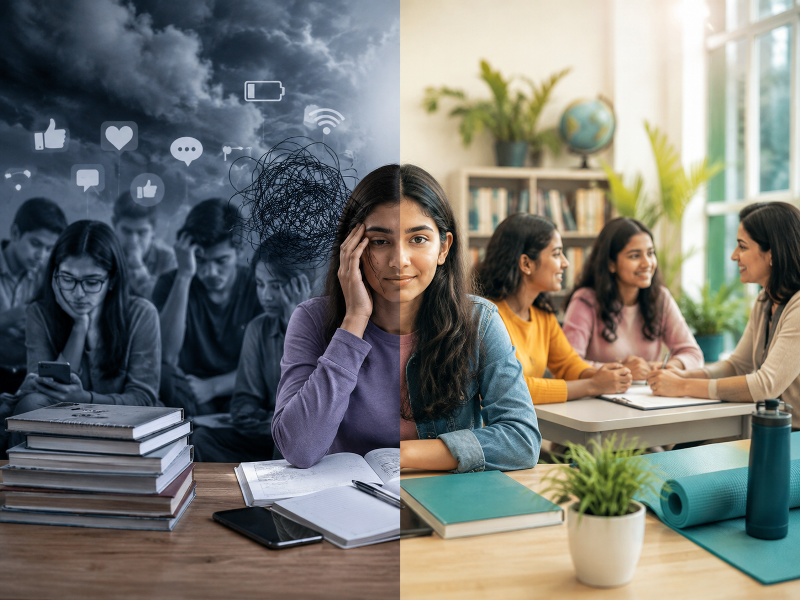
The data is clear. The causes are real. And the school environment matters more than most people realise.
People’s Public School | Bhopal | August 2026
The numbers worth knowing before anything else
4 in 10 Gen Z adults globally say they feel anxious or stressed most or all of the time. That is from Deloitte’s 2025 Global Gen Z and Millennial Survey — one of the largest annual studies tracking this generation’s mental health across 44 countries.
A 2024 Gallup and Walton Family Foundation study found Gen Z reported the poorest mental health of any generation currently alive. Not the most reported. The poorest. And a 2025 Harmony Healthcare report found that nearly half of Gen Z had already received a formal mental health diagnosis — anxiety leading every category.
In India, the picture is no different. EY reported that Indians spent an average of 4.95 hours per day on phone apps in 2024. Most of those hours belonged to teenagers. Social media addiction among those aged 15 to 24 has been directly linked to anxiety, depression, low self-esteem and compulsive scrolling by the Indian government’s own economic survey data.
These are not vague feelings being misread as mental health problems. They are documented, clinical, measurable patterns running through an entire generation.
Why this particular generation
Every generation faces hard things. What makes Gen Z’s anxiety different is not the difficulty itself — it is the combination of everything landing simultaneously in a way no previous generation ever had to navigate.
They grew up inside a pandemic that cancelled the social development years most adolescents take for granted. They entered teenage life in an always-on digital environment where comparison never switches off, where rejection lands publicly and where everyone else’s curated life runs on a loop twenty-four hours a day. They are the first generation to have grown up entirely inside social media — not as something added to their social life but as the primary location where their social life actually happens.
GlobeScan’s research found Gen Z is more than twice as likely to frequently experience stress and anxiety compared to Baby Boomers. That gap is not about resilience. It is about environment. The world Gen Z is growing up in is genuinely more psychologically demanding than the one their parents navigated at the same age. And then on top of all of it, Indian teenagers step into a school system that adds academic pressure to everything that digital life is already doing.
What this looks like inside a classroom
A teacher standing in front of thirty students in Bhopal in 2026 is not standing in front of thirty young people having ordinary teenage experiences.
They are standing in front of students who checked their phones before school, who are carrying social dynamics that play out in comment sections and group chats in ways no teacher can see, who may have had something land at midnight and arrived at school still carrying it without telling anyone.
The child who cannot concentrate is not always a child who does not care. Sometimes they are a child sitting with something they have no language for yet — no space to name it, no person to bring it to, no sense that what they are feeling has anything to do with anything outside their own head.
40% of Gen Z workers report feeling anxious or depressed at least a few times a week according to The Hartford’s 2025 workplace study. Those are young adults already in employment. The students currently in school are forming inside the same environment that is producing those numbers.
What schools can actually do about it
The school environment is one of the most powerful variables in a young person’s mental health — more powerful than most institutions give themselves credit for, in either direction.
A school that treats this as something addressed in one assembly per year is not doing much. A school that builds it into the daily texture of how children are treated, how mistakes are handled, how time is structured and how achievement is defined — that school is doing something that follows students well past graduation.
Physical activity is not separate from mental health. It is part of the mechanism. Research consistently shows that regular physical movement reduces cortisol, improves mood regulation and builds the kind of nervous system stability that makes everything else — including learning — easier. The co-curricular programme at People’s Public School treats sport and physical engagement as core to the school day, not as extras that disappear when exam season arrives.
The classroom environment shapes more than academic outcomes. A child who feels safe to get something wrong learns differently from one who cannot afford to be wrong in front of their peers. The academic approach at People’s Public School is built around participation, active thinking and genuine engagement — not passive reception of information that gets tested and forgotten.
The relationship between a student and a trusted adult inside a school is the single strongest protective factor against adolescent anxiety that research consistently identifies. Not the curriculum. Not the exam results. The teacher who noticed. The adult who asked how they were and actually waited for the answer. Schools that build the conditions for those relationships — in culture, in class size, in how the day is structured — are doing the most important mental health work available without calling it mental health work.
Recognition that extends beyond academic achievement matters too. A generation already measuring itself against curated perfection online needs to see more versions of what counts. Leadership, creativity, persistence, service, courage under difficulty — these are not soft additions to school life. They are corrections to a cultural message that is making an entire generation feel like they are not enough. The values at People’s Public School are built around producing students who carry a wider sense of their own worth than their last exam result can give or take away.
The honest bottom line
Gen Z is not fragile. They are navigating something genuinely harder than what came before them. A digital environment engineered to produce anxiety. An uncertain future. A school system that was not designed for the mental health landscape they are living inside.
The schools that take that seriously — that build environment, relationships, physical activity and a broader definition of what matters into how they actually operate every day — are not just producing better students. They are producing people who are more capable of managing the world they are actually going to live in.
That is what a good school in Bhopal in 2026 needs to look like.
Admissions for 2026-27 are open at People’s Public School Bhopal
Sources
- Deloitte Global Gen Z and Millennial Survey, 2025
- Gallup and Walton Family Foundation, Gen Z Mental Health Study, 2024
- Harmony Healthcare IT, State of Gen Z Mental Health, 2025
- The Hartford, Gen Z Workplace Mental Health Survey, 2025