Walk into any school in India and the pattern is familiar. Rows of desks, a board at the front, children copying notes they’ll revise before exams and forget shortly after. It’s the system most of us grew up in. It produced doctors, engineers, professionals and yet, if we’re being honest, very few of us would say it taught us how to think.
That gap between knowing something and understanding, it is exactly what parents are starting to notice. And it’s why more families in Bhopal are looking more carefully at how their child is being taught, not just what they’re being taught.
Something Shifts the Moment You Walk In
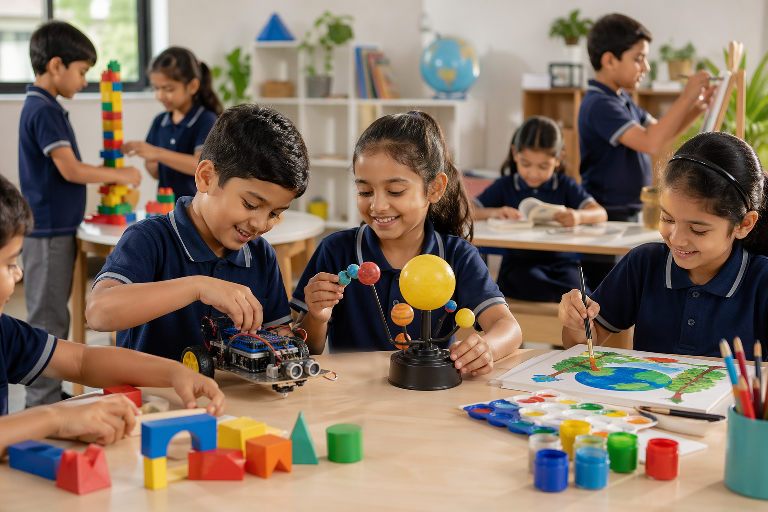
The Cambridge classrooms at People’s Public School in Bhopal don’t feel like what most of us grew up in. Children are talking to each other, to their teacher, about ideas they’re genuinely working through. Some groups are mid-debate. Others are figuring out why their experiment went wrong. One child is explaining something to a classmate and understanding it better herself in the process.
This is what activity-based learning actually looks like. Not a term on a prospectus,l a way of running a classroom where children are participants, not passengers. Where getting the wrong answer isn’t a failure. It’s the beginning of getting somewhere.
What the Cambridge Programme Means in Real Terms
People’s Public School follows the Cambridge Assessment International Education (CAIE) curriculum used across more than 160 countries and backed by the University of Cambridge.
In the early years, the goal isn’t filling a child’s head with facts. It’s building the habit of asking why. As they grow older, the work deepens projects, discussions, independent research. By the time students reach Cambridge IGCSE, they’ve been thinking critically and working independently for years. The exams feel like a natural conclusion, not a sudden mountain to climb.
The Change That Doesn’t Show Up on a Report Card
Parents whose children have spent a few years in the Cambridge International Programme notice something that has nothing to do with grades.
Their child argues back properly. Asks questions at dinner that catch you off guard. Sits with a difficult problem longer than before, because they’ve stopped expecting answers to come quickly.
That shift doesn’t come from textbooks. It comes from years in a space where a child’s curiosity is treated as an asset, not an inconvenience. It’s quiet. But over time, it shapes everything.
Come and See It for Yourself
Forget rankings and brochures for a moment. Think about your child at twenty-five, not their grades, but who they are. Whether they wait to be told what to do, or whether they figure it out.
That quality is built slowly, in the ordinary days of childhood.
People’s Public School is building that. One school day at a time.
Admissions are open. Don’t decide based on a website, come in, walk the campus, sit in on a class. Some things only make sense once you’ve seen them in person.
Apply Now & Secure Your Child’s Seat