
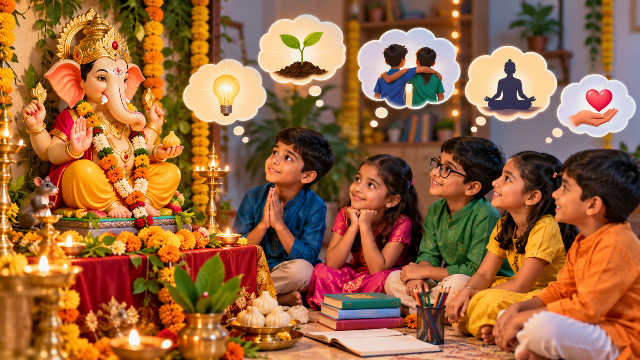
Quick question. Why does a festival about an elephant-headed god born from clay still get this loud, this joyful, every single year? Turns out there’s a lot more packed into those ten days than most people ever stop to unpack.
What the festival is actually marking
Ganesh Chaturthi celebrates the birth of Lord Ganesha, the god of new beginnings and the remover of obstacles
Falls on the fourth day of Bhadrapada, and runs for ten days, ending with visarjan
Before starting anything new, a wedding, an exam, a first day somewhere, people call on Ganesh first
The festival wasn’t always this public, it became a large community celebration a little over a hundred years ago, meant specifically to bring people together
Ends with the idol being immersed in water, a goodbye that somehow still catches people off guard emotionally, year after year
A few old stories worth knowing (and asking your kids about)
Parvati shaped Ganesha from turmeric paste with her own hands, and set him to guard her door while she bathed. Shiva came home, didn’t recognise him, and in the confusion that followed, cut off his head. Ask a kid what they’d do if someone they loved was hurt because of a misunderstanding, this story tends to open that up fast.
To fix what happened, Shiva sent his followers out to bring back the head of the first creature they found, an elephant. Ganesha got his life back, just with a head that wasn’t his to begin with. Worth asking kids if they think that made him any less himself.
Ganesha agreed to write down the entire Mahabharata as Ved Vyas dictated it, but only if Vyas never paused mid-verse. Vyas agreed, and quietly added his own condition, that Ganesha understand every line before writing it. Good one to ask kids, who do they think actually won that deal?
Before starting any journey around the world, Ganesha’s brother Kartikeya raced off on his peacock. Ganesha simply walked around his own parents once, and said that was his whole world. Ask a kid what they think “the whole world” means to them.
A mouse became his loyal vehicle after a mishap in the forest, small, unlikely, but Ganesha never left him behind for something more impressive. Ask a kid why they think that particular pairing stuck.
Why it sticks with kids beyond ten days
Shows them that starting over, differently than before, doesn’t make you any less whole
Builds patience, since most of these stories reward thinking things through, not rushing in
Grows genuine curiosity, since almost every Ganesha story has a second layer once you actually sit with it
Teaches that loyalty doesn’t need to look impressive to be real
Opens a window into a tradition that’s stayed loud and alive for generations, worth wondering about
What this can look like at school
Clay modelling sessions where kids shape their own small Ganesha idol, patience and craft rolled into one
Modak-making as a hands-on activity, since it’s known to be his favourite and kids genuinely enjoy the mess of it
Storytelling circles where these legends get told, then actually talked through together afterward
Dhol and aarti sessions kids can join in on, not just watch from the side
Small group discussions on what “removing obstacles” means in a kid’s own everyday life
A curious twist worth asking kids
Why do you think a god shaped from clay by his own mother is the one everyone turns to first?
If you had to pick one unlikely companion, like Ganesha’s mouse, who would it be and why?
What’s one obstacle you’ve actually gotten past this year, and how did you do it?
Doing it without piling on waste
Clay idols instead of plaster ones, since clay breaks down naturally instead of sitting in a river for years
A hands-on workshop where kids shape and paint their own eco-friendly idol
Choosing a bucket or tub immersion at home over a crowded water body, when that’s an option
Where People’s Public School comes in
Ganesh Chaturthi here isn’t squeezed in as a quick activity between two periods
It’s given the space a festival like this actually deserves
Kids connect with the tradition instead of just performing it for a photo
See how celebrations like this fit into the school’s broader approach on the Unique Features page, or check admissions for the 2026-27 session.